
College Football 27 Dynasty Position Change Guide: How to Maximize Player Development, Archetypes, and Skill Caps
Jul-22-2026 PSTSummary:
College Football 27 Dynasty Mode introduces a deeper position change system that can completely transform how players develop. From fixing incorrect archetypes to unlocking hidden potential, smart position changes can turn average recruits into elite stars. This guide explains how to use position changes effectively, reset skill caps, optimize abilities, College Football 27 Coins, and build unstoppable teams.

Step 1: Why Position Changes Matter So Much in College Football 27 Dynasty Mode
Position changes have always been an important part of Dynasty Mode, but in College Football 27, they become one of the most powerful tools for roster management. During the offseason, especially around National Signing Day and training progression, coaches have the opportunity to reshape their teams by moving players into roles that better match their attributes.
Many players will enter your program with the wrong archetype. The game does not always dynamically update a player's role based on how their ratings develop. As a result, a player can have incredible attributes but still receive a lower overall rating because they are trapped in an unsuitable archetype.
For example, a dual-threat quarterback might actually have the perfect attributes to become a pure rushing quarterback. If his ratings focus heavily on speed, acceleration, agility, change of direction, carrying, and ball vision, leaving him as a dual-threat quarterback could limit his overall rating and prevent him from unlocking the best abilities.
By changing his position or archetype, you can unlock a higher overall rating, better abilities, and even improve his chances of becoming an NFL Draft prospect.
Step 2: Fix Players Stuck in the Wrong Archetype
One of the biggest secrets in College Football 27 Dynasty is understanding how archetypes affect player ratings.
A player's overall rating is not simply based on raw attributes. The game evaluates those attributes based on the player's current archetype. If the archetype does not match the player's strengths, the overall rating can be artificially lowered.
A great example is a quarterback with:
Elite speed
High acceleration
Strong ball carrying
Excellent agility
Good vision
This player might technically be listed as a dual-threat quarterback, but his attributes may better fit a pure runner archetype. Moving him to another position and back can sometimes force the game to recognize his true style.
The result can be a massive overall increase.
A quarterback stuck at an 84 overall could suddenly become an 88 or 90 overall after receiving the correct archetype. This does not mean the player gained new ratings instantly. Instead, the game is now evaluating him correctly.
Step 3: Understand How Position Changes Affect Skill Caps
One of the most important mechanics in College Football 27 is how position changes interact with skill caps.
Skill caps determine how far a player can improve throughout their career. Position changes can either preserve these caps or completely change them depending on how you move the player.
If you move a player within the same position group, such as:
Cornerback to Safety
Linebacker to Edge Rusher
Defensive Tackle to Defensive End
Receiver to Tight End
the player's skill caps often remain the same.
For example, moving a cornerback to safety may increase his overall rating, but his skill caps could stay identical.
However, moving a player to a completely different side of the ball can create a different result.
A cornerback moved to quarterback and then moved back to corner may receive completely different skill caps. This creates an opportunity to unlock more development potential.
But this strategy must be used carefully.
If you already have a player with excellent skill caps, randomly changing positions can actually hurt their future growth. The best time to use this method is when a player has already reached his maximum potential and you believe his development has ended too early.
Step 4: The Best Time to Reset Skill Caps
Position changes should not be used randomly. Timing is everything.
The ideal situation is when you have:
A freshman or sophomore player
A player who developed too quickly
A prospect with limited skill caps
A player with elite physical traits but poor development potential
For example, imagine finding a cornerback with:
99 coverage ability
81 speed
Great size
Elite defensive instincts
but his skill caps are already maxed out.
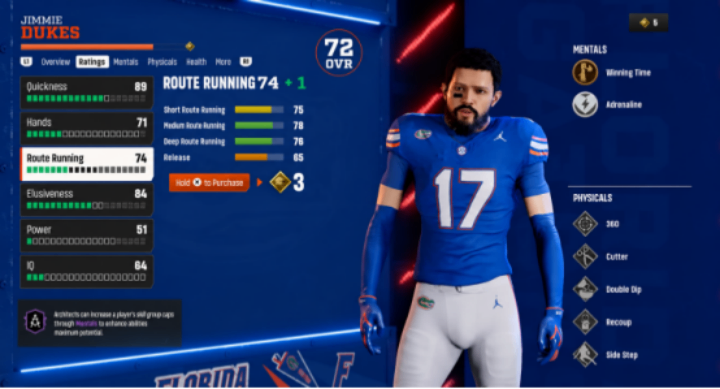
Instead of accepting that he has reached his limit, you can move him to another position group and back. This can refresh his development path and allow him to continue improving.
This strategy is especially useful for unique athletes who have rare physical builds.
Step 5: Create Unique Players Through Position Changes
Some of the best players in College Football 27 may not come from traditional recruiting.
Position changes allow you to create special player types that are difficult to find naturally.
For example:
Derrick Henry Style Running Back
A huge, powerful running back with:
Size
Strength
Speed
Contact balance
may only be possible through position changes.
Cam Newton Style Quarterback
A massive quarterback who can:
Run effectively
Break tackles
Throw accurately
Dominate physically
is another example of a player type that can require position changes.
These transformations make Dynasty Mode more creative because you are no longer limited by recruiting archetypes.
Step 6: Use Position Changes to Improve Receiver and Tight End Archetypes
Wide receivers are another position where archetype optimization matters.
Some receivers may have excellent physical traits but poor archetype matches.
For example, a possession receiver may become a much better tight end.
A receiver who moves to tight end could gain:
Higher overall rating
Better blocking potential
A more valuable vertical threat archetype
The same concept applies to speed receivers.
A speedster receiver is only valuable if he has the necessary acceleration and change-of-direction ratings to unlock elite abilities.
If a player lacks those requirements, changing his archetype may create a better long-term player.
Step 7: Be Careful About Losing Abilities
While position changes are powerful, they come with risks.
Changing a player's archetype can remove existing abilities.
For example, moving a linebacker to edge rusher might increase his overall rating, but he could lose three valuable abilities.
Before making any change, ask:
Will the new archetype unlock better abilities?
Are the lost abilities more valuable?
Does the player fit my defensive system better?
Sometimes keeping a player at his original position is the smarter choice.
A lower overall player with elite abilities can outperform a higher overall player without them.
Step 8: Optimize Quarterbacks Through Archetype Changes
Quarterbacks are one of the most interesting positions for position changes.
Some quarterbacks enter Dynasty Mode with archetypes that do not match their play style.
A dual-threat quarterback might actually perform better as a pocket passer because pocket passer abilities are easier to unlock for certain offensive systems.
Likewise, a backfield creator quarterback could become a better pocket passer if his attributes focus on:
Throw power
Accuracy
Awareness
Decision making
The key is not always chasing the highest overall rating. Instead, you want the archetype that provides the abilities your offense needs.
Step 9: Convert Linebackers and Defensive Players Correctly
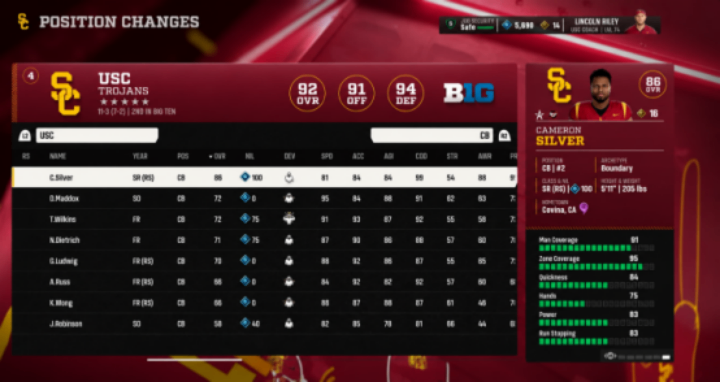
Defensive players also benefit greatly from position changes.
One example is moving lurking middle linebackers to outside linebacker.
Outside linebacker lurker archetypes often have access to more upgrade categories, including:
Zone coverage
Man coverage
Catching
Press
Spectacular catch
This gives players more development flexibility.
If two players have similar ratings but one archetype offers more upgrade paths, choosing the better development route can create a future superstar.
Step 10: Build Your Dynasty Around Smart Position Management
The best College Football 27 Dynasty coaches will not simply recruit the highest-rated players. They will identify hidden potential and maximize every athlete.
Before every offseason progression period, review your roster:
Are players in the correct archetype?
Are their abilities matching your scheme?
Are their skill caps limiting development?
Can a position change unlock more potential?
A simple position change can turn a backup player into a superstar.
College Football 27 rewards coaches who understand the details behind player development. By mastering archetypes, skill caps, and position conversions, you can create unique players, cheap College Football 27 Coins, dominate recruiting, and build a dynasty that lasts for decades.